Customer Success is gaining relevance— and working its way to the boardroom agenda
- Rakesh Gopinathan
- Jun 13, 2022
- 5 min read

Increasingly, technology enterprises are setting up and scaling Customer Success (CS) functions to proactively manage customer relationships and customer value. Our new enterprise-scale survey evaluates how companies are benefiting from CS and what key challenges exist in elevating the CS agenda.
The shift to a flexible consumption or everything-as-a-service (XaaS) model is perhaps the most disruptive phenomenon in how technology is purchased and consumed. Gartner estimates that by 2020, all new entrants and 80 percent of historical technology solution providers will offer subscription-based services.
Not only has this shift empowered customers with greater flexibility in how (and how much) they consume, and pay for services, it has also enabled them to be nimble in accessing newer and better technology. According to a recent Deloitte study, business agility is well on its way to surpass operational efficiency as a driver for XaaS adoption. As this demand for agility raises the bar for customer expectations, technology businesses are pivoting from a linear sell-renew approach to a dynamic and continuous customer engagement model to help customers derive more value from using their products or services.
Many companies have established a CS function to focus on developing, growing, and sustaining relationships with customers. CS started as a churn-prevention team for SaaS businesses, and is now a growing discipline within the broader technology industry. As CS evolves, its focus is expanding from customer retention to managing the end-to-end customer journey, from developing better products to driving customer adoption, retention, and growth.
To better understand how enterprises are setting up CS, what they are gaining, and the challenges they face, Deloitte conducted a CS survey in March 2019, surveying close to 50 CS leaders from enterprise-scale businesses.
Top findings
CS goes mainstream and is driving tangible value
More and more tech companies are formally embracing CS functions.
• Approximately 70 percent of respondents have had CS teams in operation for more than two years, while 45 percent reported having a CS team that is more than four years old.
• More than half of the respondents gained 10 percent higher up-sell and cross-sell revenue, renewal rates, and annual recurring revenue. Annual recurring revenue was the most positively impacted metric, with nearly a third of respondents seeing a 20 percent or greater uptick.
CS results in happier customers
Respondents have seen noticeable improvements in the level of customer satisfaction and brand advocacy thanks to their CS efforts.
• Half are experiencing a rise in Customer Satisfaction Scores (CSAT) by more than 20 percent.
CS mindset is starting to permeate across the enterprise, but more work must be done to make it an organisation-wide philosophy
Among the objectives outlined by CS leaders, reducing churn and retaining customers continues to be the most important, with 35 percent respondents ranking it as the leading objective today, when compared to designing and developing better offerings for customers, which stands at 10 percent. As a result, a majority of the CS team’s time is spent on post-sales activities, with members spending 60 percent of their time ensuring proper customer onboarding, driving higher adoption and up-sell/cross-sell opportunities, and reducing churn.
In fact, the survey found that the No. 1 challenge faced by CS leaders today is defining a cross-functional operating model, making it harder to embed the CS philosophy across the enterprise.
CS is yet to get the required boardroom attention
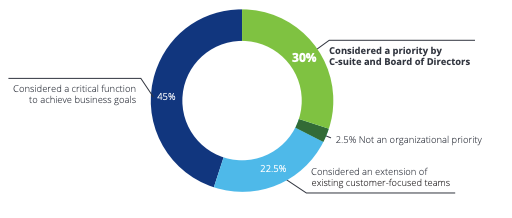
Most companies understand the need for establishing a dedicated CS function and its potential business value. But very few tech companies have been able to elevate the strategic importance of CS within their organisations.
• Just one-third of respondents said their CS function is led by a C-suite executive. A mere 30 percent report that CS is considered a strategic priority by the board of directors. Only 26 percent say CS finds a regular mention in official business communications.
• Companies that consider CS as a strategic priority saw higher improvement in metrics, with roughly twice the number of companies reporting a double-digit improvement in renewal rates.
Success of tech companies rests on embracing CS principles beyond just having a CS group. Functions across the organisation need to adopt the CS mindset.
The importance of elevating CS to the boardroom
Not all technology businesses today think of CS as being more strategic than driving better retention and renewals. We analysed the survey results across five key characteristics of enterprises where CS is considered a strategic priority and where the C-suite and board of directors regularly review CS outcomes. There are noticeable differences in the approach taken by these CS-focused organisations that have helped CS leaders to gain visibility and attention from organisations’ leaders and scale the CS function. Some of the unique characteristics are summarised to the right:
Self-sustainable funding and monetisation models
Greater CS reach
Self-sustainable funding and monetization models
Better technology adoption and talent models
Demonstrable improvement in customer health
Here is a detailed look at five key insights into the state of CS that we observed in our research.
CS is a developing mindset and needs to be infused across the enterprise
A CS mindset exists where a constant focus on the customer is maintained throughout all touch-points and value creation stages. However, survey results indicate that CS functions have been largely focused on working with customers only once a transaction is completed. CS employees spend 60 percent of their time dedicated to ensuring proper customer onboarding, driving higher adoption and up-sell/crosssell, and reducing churn. Only 40 percent of their time is allocated toward designing better products, delivering more accurate business models, defining success plans, and building package structures that are more closely aligned with customer needs. Among the strategic objectives outlined by CS leaders, the narrow goal of reducing churn and retaining customers continues to be given a fairly high level of importance, with 35 percent of respondents ranking it as the leading objective today. The critical goal of designing and developing better offerings for customers is stacked at the bottom, with only 10 percent of respondents ranking it as their most important objective.
CS functions must act as a connecting thread across different stages of the customer journey that binds multiple internal teams together—from product development, sales, and professional services to support and renewals—to ensure that a consistent view of the customer is adopted across the organisation with a unified focus to maximise value for customers at every step of their journey. This is enabled by a CS discipline that builds a closed value loop ensuring that customer feedback and insights from post-sales phases are shared across the organisation to build a holistic understanding of the customer’s unique needs, preferences, and pain points.

A key requirement for the CS mindset to permeate throughout the organisation and achieve the desired results is the development of robust operating models that enable the CS function to collaborate with critical internal teams. A robust operating model helps orchestrate an environment where existing functions and CS work together and ensure that a consistent focus on the customer is maintained throughout the organisation. Our survey results indicate that while businesses have started to define steady CS operating models, they continue to face challenges in gaining cross-functional alignment to encourage a consistent customer-centric view across teams.


Comments